Service area
Well pump repair in Magalia, CA
Magalia sits up the ridge above Paradise, higher and steeper, and the pump work here reflects that. Deep hard rock wells, difficult access, and a lot of properties where the same people have lived for a very long time on equipment that has been in the ground since well before anyone was thinking about replacing it. Call to get connected with a licensed local pump contractor.
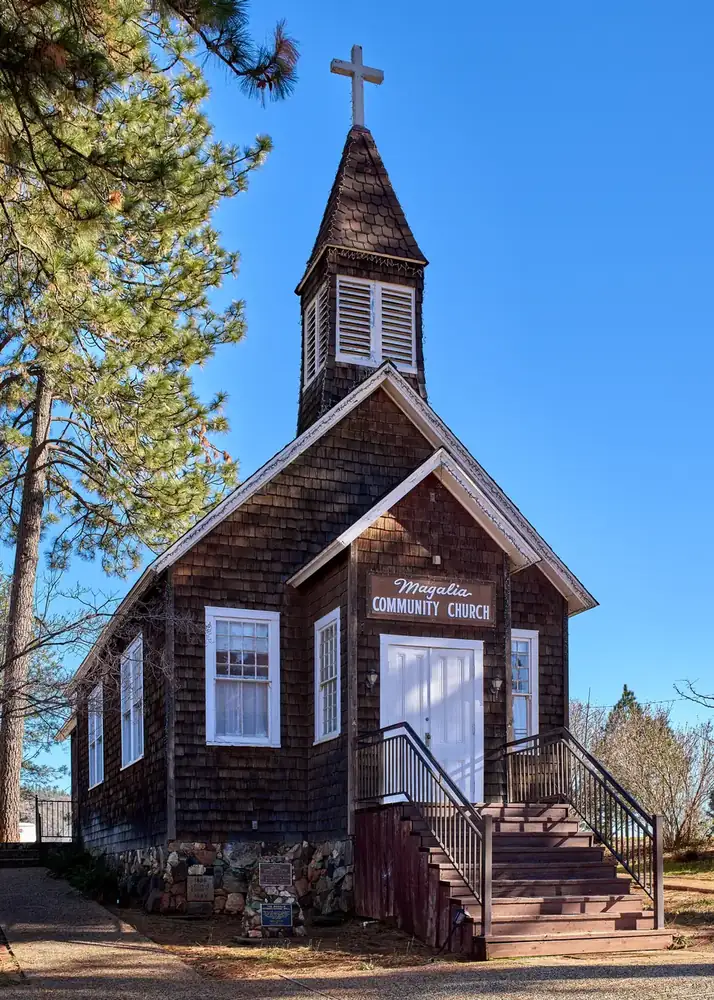
Two kinds of property, side by side
Magalia is mixed in a way that Paradise is not. The Camp Fire burned through part of the community in 2018 and left other parts standing. The result, in pump terms, is that neighboring parcels can be in completely different situations.
On one side you have rebuilt property: new construction on a well that predates it, wellheads and pump houses that were replaced, and a system where everything visible is recent and everything below the casing is not. On the other side you have houses that came through untouched and are still running the equipment they have always run. Both are normal calls here. They just fail differently.
What ties them together is that the well itself is almost never new. Whatever happened above ground, the hole is as old as it ever was, and it is the hole that sets the price.
Original pumps, well past their expected life
This is the Magalia specific. A lot of ridge property has been in the same hands for decades, and rural people do not replace equipment that is working. Fair enough. But a submersible pump has a service life of roughly 8 to 15 years, and a meaningful share of the pumps up here are past the top of that number and still going.
A pump running at 25 years is not a testament to your luck. It is a pump that owes you nothing, and the useful thing to know is what happens when it finally stops. It does not usually give notice. It works on Tuesday and does not work on Wednesday, and Wednesday is when you find out that nobody has pulled that well since the Clinton administration and the pipe has spent 25 years threading itself into place.
Old installations bring their own complications on the way out. Galvanized drop pipe that has been in the ground for decades corrodes at the threads, and it can part while it is being lifted, which is the exact scenario that drops several hundred pounds of column to the bottom of the well. Wire insulation goes brittle. Torque arrestors and old splices come apart in your hands. None of that is a reason to panic, but it does mean the crew works carefully and that a very old well is a slower job than a fifteen year old one.
The realistic advice: if your pump is past 15 years and still running, you are not obligated to replace it. But it is worth knowing your depth, your pump specs, and where your paperwork is now, while the water still runs, rather than trying to piece it together on the phone on the morning it quits. A well inspection runs $200 to $400 and gets all of that written down.
Original pump still running after 20 years? Worth knowing what is down there.
Depth is what you are paying for
Magalia is hard rock country, higher than Paradise, and the wells go deep. Water up here lives in fractures rather than in an aquifer, so a driller kept going until he hit a seam, which is why 300 to 400 feet and beyond is ordinary rather than remarkable.
That is the whole reason a Magalia quote does not look like an Oroville quote. A submersible replacement here generally runs $2,800 to $5,500. The same pump, in the same box, in a 150 foot valley well down on the floor runs $1,500 to $3,000. Depth adds roughly $500 to $1,000 per additional 100 feet, and that is drop pipe, wire, and hours of hauling a heavy column of pipe out of the ground and putting it back straight. If a friend in Gridley tells you they paid $1,800, they are not getting a better deal. They have a shorter hole. The full breakdown is on the well pump replacement cost page.
Steep ground and getting a truck to the wellhead
A pump hoist has to sit directly over the casing, which means a full size service truck has to reach it. On the ridge that is frequently the hard part of the day. Driveways are long, narrow, gravel, and cut into a grade, and a lot of them were built for a pickup rather than a loaded rig. Wellheads end up downhill from the house, or tucked behind a structure, or at the far end of the parcel where the water happened to be.
Mention it when you call. How far the wellhead is from where a truck can park, how steep the driveway is, whether anything large has made it up recently. It is not a test. It is how the crew shows up with the right vehicle and does it in one trip instead of two, and access time is on your bill either way.
Check these before you spend anything
Three free checks that cost you nothing and sometimes save a service call. Push the double pole breaker firmly off and back on, since a tripped breaker does not always look tripped. Read the gauge near the pressure tank: pressure at the gauge but no water in the house means the pump is doing its job and the problem is downstream. And knock on the tank, top and bottom. Hollow up high and solid down low is a healthy tank. Solid the whole way up is waterlogged, and a waterlogged tank makes a good pump switch on and off constantly, which is what actually kills pumps up here.
If all three look right, a diagnosis runs $95 to $185 and is usually credited toward the work. A pressure switch is $150 to $350 and fails far more often than a pump does, which is worth ruling out before anyone pulls 400 feet of pipe. More on the repair page, and on replacement if it comes to that.
Nearby
The contractors we refer cover Paradise just down the ridge, the deep hard rock wells across the canyon in Berry Creek, and the shallower valley wells down in Oroville.
Get connected with a licensed local pump contractor.